
Why Swing Trading Remains the Most Practical Forex Strategy for Part-Time Traders

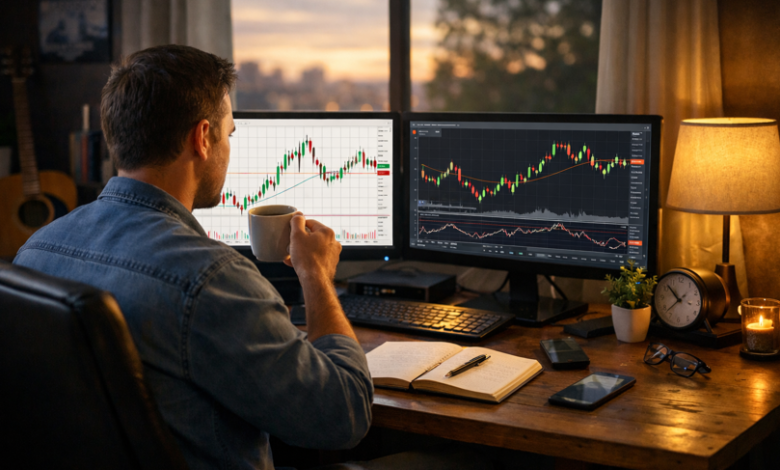
The image of a forex trader glued to six monitors with charts flashing red and green is one of the most persistent myths in the trading world. It suggests that success requires constant attention, split-second decisions, and full-time dedication. For the vast majority of people interested in trading currencies, this image is not only intimidating — it is misleading.
Swing trading offers an alternative that aligns far better with how most people actually live. It does not require watching charts all day. It does not demand lightning-fast reflexes. And perhaps most importantly, it produces some of the most consistent results among retail forex traders precisely because it avoids the noise, overtrading, and emotional exhaustion that destroy shorter-timeframe approaches.
What Makes Swing Trading Different
At its core, swing trading in forex is about capturing medium-term price movements that develop over days to weeks. Unlike day traders who enter and exit positions within hours, or scalpers who trade in seconds, swing traders identify a directional move forming on the four-hour or daily chart and ride it until the momentum fades.
This timeframe sits in a sweet spot. It is long enough to filter out the random noise that dominates lower timeframes, but short enough to avoid the extended drawdowns and overnight risk that position traders face. A swing trader might take three to five trades per week, spending 30 minutes each morning analysing charts and managing positions. The rest of the day is free.
For professionals, parents, students, or anyone with commitments beyond trading, this structure is transformative. You can maintain a career, a family, and a social life while still actively participating in the largest financial market in the world.
The Edge of Patience
One of the least discussed advantages of swing trading is psychological. Day trading and scalping demand rapid decision-making under pressure. Every tick matters. A moment of hesitation can turn a winner into a loser. This environment breeds stress, impulsive behaviour, and emotional decision-making — the three biggest killers of trading accounts.
Swing trading operates at a different pace. You have time to analyse a setup properly before committing. You can walk away from the chart, think about it over lunch, and come back with fresh eyes. There is no urgency to enter right now because the moves you are targeting take days to develop, not minutes.
This patience naturally filters out low-quality trades. A day trader might force ten trades in a slow market because they feel they need to be active. A swing trader in the same market sees nothing worth taking and simply waits. Doing nothing when conditions are unfavourable is one of the most profitable skills in trading, and swing trading makes it easier to practise.
Reading the Daily Chart
The daily chart is the swing trader’s primary tool. Each candle represents a full day of market activity — the opening price, the closing price, the highest and lowest points reached during that session. This level of data compression strips away the noise that clutters lower timeframes while preserving the meaningful price action that drives tradeable moves.
On the daily chart, support and resistance levels become clearer. Trends are easier to identify. Candlestick patterns carry more weight because they represent the consensus of an entire day’s worth of buying and selling. A pin bar on the daily chart reflects a genuine shift in market sentiment, whereas the same pattern on a five-minute chart might just be a reaction to a single large order.
Most successful swing traders combine price action analysis on the daily chart with one or two confirming tools. Understanding how technical indicators work — from moving averages to RSI and ATR — gives swing traders an objective framework for assessing trend direction, momentum strength, and volatility conditions. These simple tools, applied on the daily timeframe, provide more reliable signals than a dozen indicators stacked on a one-minute chart.
The Setup: Simplicity Over Complexity
A common trap for developing traders is the belief that more complex strategies produce better results. They layer indicator upon indicator, add multiple timeframe confirmations, and create rule sets so complicated that they cannot follow them consistently under pressure.
The best swing trading setups are remarkably simple. A trend defined by a moving average. A pullback to a key support or resistance level. A candlestick signal confirming the rejection. An entry with a stop loss below the recent swing low and a target at the next structural level. That is it.
This simplicity is not a weakness — it is the entire point. A simple system is easier to follow, easier to repeat, and easier to evaluate. When something goes wrong, you can identify the issue quickly. When something works, you know exactly why.
Consider a basic swing trading approach on EUR/USD. The pair is trending above its 50-period moving average on the daily chart. Price pulls back to a previous resistance level that has now flipped to support. A bullish engulfing candle forms at that level. You enter long with a stop loss below the engulfing candle’s low and target the previous swing high.
This setup uses three elements: trend direction, structural level, and candlestick confirmation. No proprietary indicators. No complex algorithms. Just three pieces of information that together create a high-probability trade with a clearly defined risk.
Risk Management: The Non-Negotiable
Swing trading’s longer holding periods mean that positions are exposed to overnight gaps, unexpected news events, and weekend risk. This makes risk management not just important but essential.
The standard approach is to risk one to two percent of your account on any single trade. This means calculating your position size based on the distance between your entry and stop loss, ensuring that if the trade fails, your maximum loss is a known, acceptable amount.
Because swing trades typically have wider stop losses than day trades — reflecting the larger price swings on higher timeframes — position sizes are naturally smaller. This is not a disadvantage. A smaller position on a higher-probability setup with a favourable risk-reward ratio will outperform a larger position on a noisy, low-timeframe trade over the long run.
Swing traders should also be mindful of correlation risk. Holding long positions on EUR/USD, GBP/USD, and AUD/USD simultaneously is essentially a triple bet against the US dollar. If the dollar strengthens unexpectedly, all three positions lose money at once. Monitoring currency correlations and limiting exposure to any single directional theme is basic but often overlooked risk management.
Validating Your Approach
One of the most significant advantages of swing trading is that strategies are straightforward to test. Because signals occur on daily or four-hour charts, historical data is readily available and easy to work with. A swing trading strategy that generates three to five signals per week produces enough data points over a few months of testing to draw meaningful conclusions about its viability.
The importance of backtesting a forex strategy before trading it with real money cannot be overstated. Walking through historical charts and applying your rules to past price action reveals whether your edge is real or imagined. It also exposes weaknesses that are invisible in theory — perhaps the strategy performs well in trending markets but produces consistent losses during ranges, or perhaps the win rate drops significantly during certain months.
Forward testing on a demo account adds another layer of validation. It introduces the psychological element that backtesting cannot replicate — the experience of watching a real-time trade develop, managing the temptation to exit early, and sitting through temporary drawdowns. A strategy that works on paper but falls apart when emotions are involved needs refinement before it touches real capital.
Common Swing Trading Mistakes
Despite its relative simplicity, swing trading has its own set of pitfalls that beginners frequently fall into.
The first is interfering with open trades. A swing trade is designed to play out over days. Checking it every hour and adjusting your stop loss based on short-term fluctuations defeats the entire purpose. Set your trade, set your stop, and let the daily chart do its work. Micro-managing swing trades turns them into poorly executed day trades.
The second is trading too many pairs simultaneously. Swing traders sometimes believe that monitoring fifteen currency pairs increases their opportunities. In practice, it dilutes attention and leads to lower-quality setups. Focusing on four to six major pairs is enough to generate consistent opportunities without overwhelming your analysis capacity.
The third is ignoring the economic calendar. Swing trades are exposed to high-impact news events — central bank decisions, employment reports, inflation data. While it is not necessary to avoid all news events, being aware of when they occur allows you to manage position size and stop placement accordingly. A trade entered the day before a Federal Reserve decision carries fundamentally different risk than the same trade entered on a quiet Tuesday.
Why It Works Long Term
Swing trading works not because it is clever or innovative, but because it aligns with how markets actually move. Currencies trend on daily and weekly timeframes in response to macroeconomic forces — interest rate differentials, trade flows, capital movements, and central bank policy. These trends develop over days and weeks, which is exactly the timeframe swing traders operate on.
By positioning yourself in the direction of these macro-driven trends and entering at structural levels where the risk-reward ratio is favourable, you are trading with the underlying forces that drive the market rather than against the random noise that dominates shorter timeframes.
Add disciplined risk management, a validated strategy, and the patience to wait for quality setups, and you have an approach that can produce consistent results over months and years. It is not glamorous. It will not make you rich overnight. But for part-time traders who want a sustainable, evidence-based method for participating in the forex market, swing trading remains the most practical and effective approach available.
This article is for educational purposes only and does not constitute financial advice. Forex trading involves significant risk, and past performance does not guarantee future results.